Budgeting: How to stop overspending before the month runs out
To stop overspending, find the one or two categories where the money leaks, put a pause between wanting something and buying it, and check your spending pace mid-month rather than at the end. In the Fed's 2025 survey, only 41% of US adults said they always or often had money left over at the end of the month.
 By Wealtie Team · 3 min read
Key takeaways
- Overspending usually comes from one or two flexible categories, not from every line of the budget.
- A waiting rule, such as 48 hours for non-essentials over a set amount, stops most impulse buys without banning anything.
- Count a buy now, pay later purchase as spending of the full price on the day you buy it, not instalment by instalment.
- In 2025, 16% of US adults used buy now, pay later, and slightly more than a quarter of users made a late payment.
- A fixed weekly amount in a separate spending account makes the limit visible: when it's empty, the week's flexible spending is done.
How to stop overspending: find where it happens first
Overspending happens in one or two categories, almost always the flexible ones. Rent and bills don't drift; eating out, shopping and small online orders do. It's common, too: in the Federal Reserve's 2025 survey, 41% of US adults said they always or often had money left over at the end of the month, which leaves most people without that margin.
Put last month's spending next to the limits you set. Here's one month in round numbers that work in any currency:
| Category | Limit | Spent | Over by |
|---|---|---|---|
| Groceries | 400 | 460 | 60 |
| Eating out | 150 | 290 | 140 |
| Shopping | 100 | 240 | 140 |
| Transport | 150 | 155 | 5 |
| Subscriptions | 60 | 75 | 15 |
| Total | 860 | 1,220 | 360 |
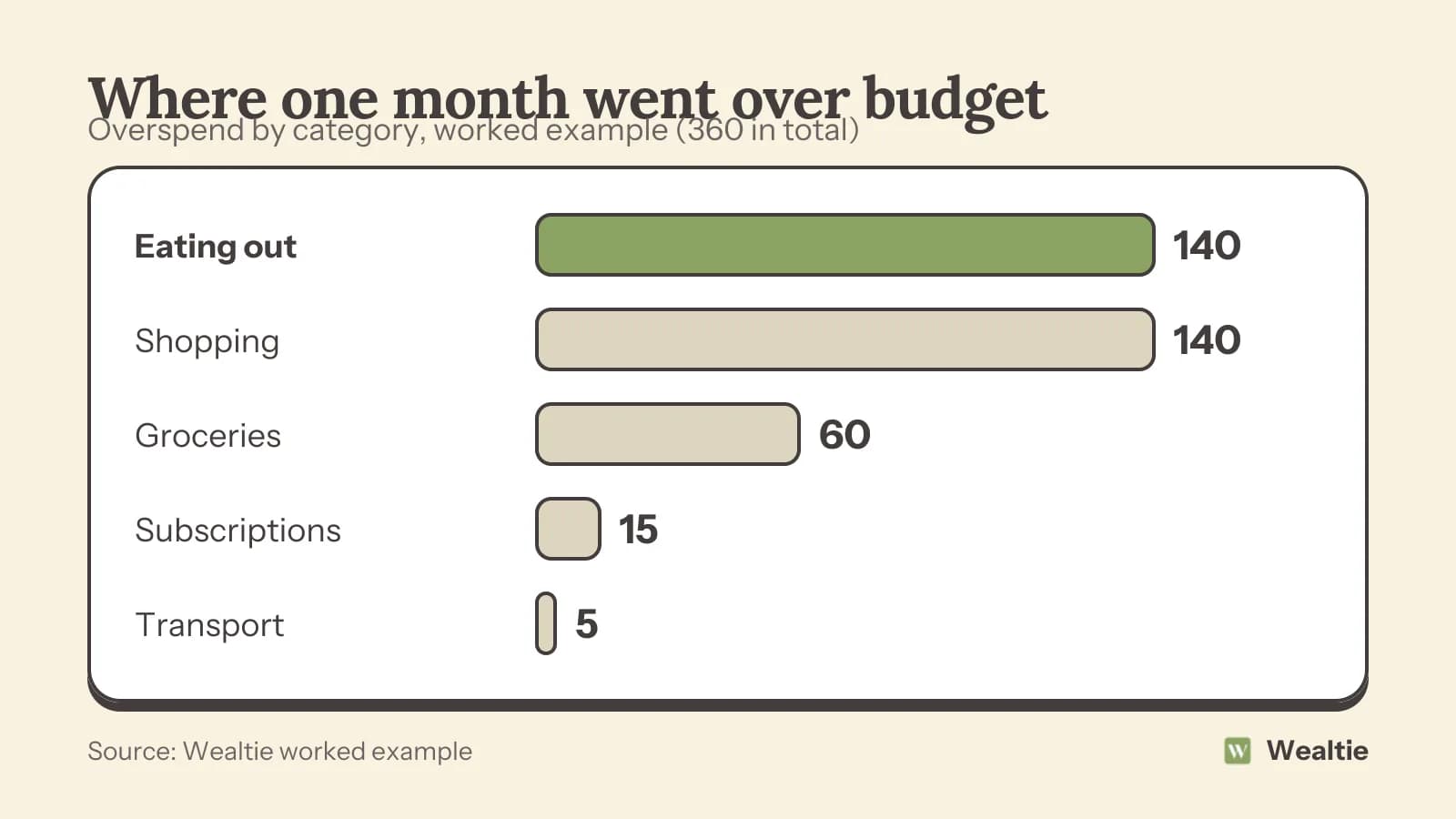
Two categories account for 280 of the 360. That's where the effort goes. Trimming transport by 5 would change nothing; a rule for eating out and one for shopping would cover most of the gap.
To get this table you need a month of spending by category. An expense tracker that takes a few seconds per entry gives you that without linking a bank, and spending analytics shows month against month and the days spending spiked.
How do you stop impulse buys?
Put a fixed wait between wanting something and buying it. For anything that isn't essential and costs more than a set amount, say 50, wait 48 hours. For anything over 200, write it on a list and buy it after 30 days if you still want it.
The rule doesn't ban anything, which is why it holds. Most impulse buys don't survive two days, and the ones that do were probably worth buying.
Black Friday, on 27 November this year, is where the rule earns its keep. Write the list before the sales start: the things you were going to buy anyway, with a price you'd pay. A discount on something on the list is a saving. A discount on something that isn't is spending you hadn't planned.
Is buy now, pay later making it worse?
It makes overspending harder to see, because the price arrives in pieces. In the Fed's 2025 survey, 16% of US adults used buy now, pay later in the prior 12 months, and slightly more than a quarter of users were late making a payment. 11% of users had a BNPL payment trigger an overdraft or insufficient-funds fee from their bank. Nearly half had used it for clothing and accessories.
The fix is in how you record it. Log the full price as spending on the day you buy, the same as a card purchase, and treat the instalments as paying it off. A 200 jacket in four payments of 50 is 200 of this month's shopping budget, not 50.
What about the small charges that repeat?
List every recurring charge once, add them up, and cancel the ones you haven't used in the past month. Subscriptions run over quietly because nobody decides to spend the money each month; it just leaves.
In the example, subscriptions came in 15 over a 60 limit. That's small on its own, but it repeats every month until something changes, and a price rise on one service is enough to cause it. Check the list when a limit is crossed, not once a year. A subscription tracker that logs each charge on its due date keeps the list current without you having to remember it.
Should you use a separate account for spending money?
It helps, because a balance that runs out is a clearer limit than a number in a budget. Work out the month's flexible spending, divide it into weeks, and move that amount into a separate account or card each week. Bills stay in the main account.
On 600 a month of flexible spending, that's about 140 a week (600 × 12 ÷ 52 = 138). When the week's 140 is gone, the flexible spending is done until the next transfer. A good week leaves money that rolls into the next one.
In Wealtie, the Free plan includes two accounts, and moving money between them is a transfer, not spending, so the weekly top-up doesn't count twice. The accounts and net worth page shows how they add up.
How do you know you're overspending before the month ends?
Check the pace halfway through, not the total at the end. Divide what you've spent by the days gone and multiply by the days in the month: on a 2,400 budget, 1,300 by day 15 of 30 ends the month at 2,600. With half the month left, that's still fixable.
The payday forecast calculator runs the sum, and Wealtie's budget forecast, Budget Health, does it after every expense you log. The other reasons a budget goes over are in why most budgets fail.
Questions people ask
Usually because one or two flexible categories, such as eating out or shopping, run over while the rest of the budget holds. Comparing last month's spending by category with your limits shows which ones.
Write a list of what you were going to buy anyway, with the price you'd pay, before the sales start. Buy only from the list, and count any buy now, pay later purchase at its full price.
It's a rule to wait 48 hours before buying anything non-essential above a set amount. Most impulse purchases don't survive the wait; for bigger items, a 30-day list works the same way.
Log every card purchase on the day you make it and check the total against your budget weekly. A separate debit account with a fixed weekly amount for flexible spending makes the limit harder to cross.
Yes, count the full price as spending on the day you buy, not each instalment as it's paid. Otherwise the purchase is spread across months and the overspending stays hidden.
Sources
- Economic Well-Being of U.S. Households in 2025: Income and Expenses · Board of Governors of the Federal Reserve System · checked 19 October 2026
- Economic Well-Being of U.S. Households in 2025: Credit (Buy Now, Pay Later) · Board of Governors of the Federal Reserve System · checked 19 October 2026
- Buy Now Pay Later · Financial Conduct Authority · checked 19 October 2026
This article is general information, not financial, tax or legal advice. Your situation is your own; check the numbers that apply to you before you act on them.