Budgeting: Weekly or monthly budget: which one you'll keep, with examples
In the weekly vs monthly budget question, use a monthly budget for bills and a weekly one for spending you do every few days, like groceries and eating out. If you're paid weekly or overspend late in the month, weekly is easier to keep; if you're paid monthly with mostly fixed bills, monthly is enough.
 By Wealtie Team · 3 min read
Key takeaways
- A monthly budget suits bills, which are mostly monthly; a weekly budget suits groceries, transport and eating out, which happen every few days.
- Many people use both: plan the month, then check the spending categories week by week.
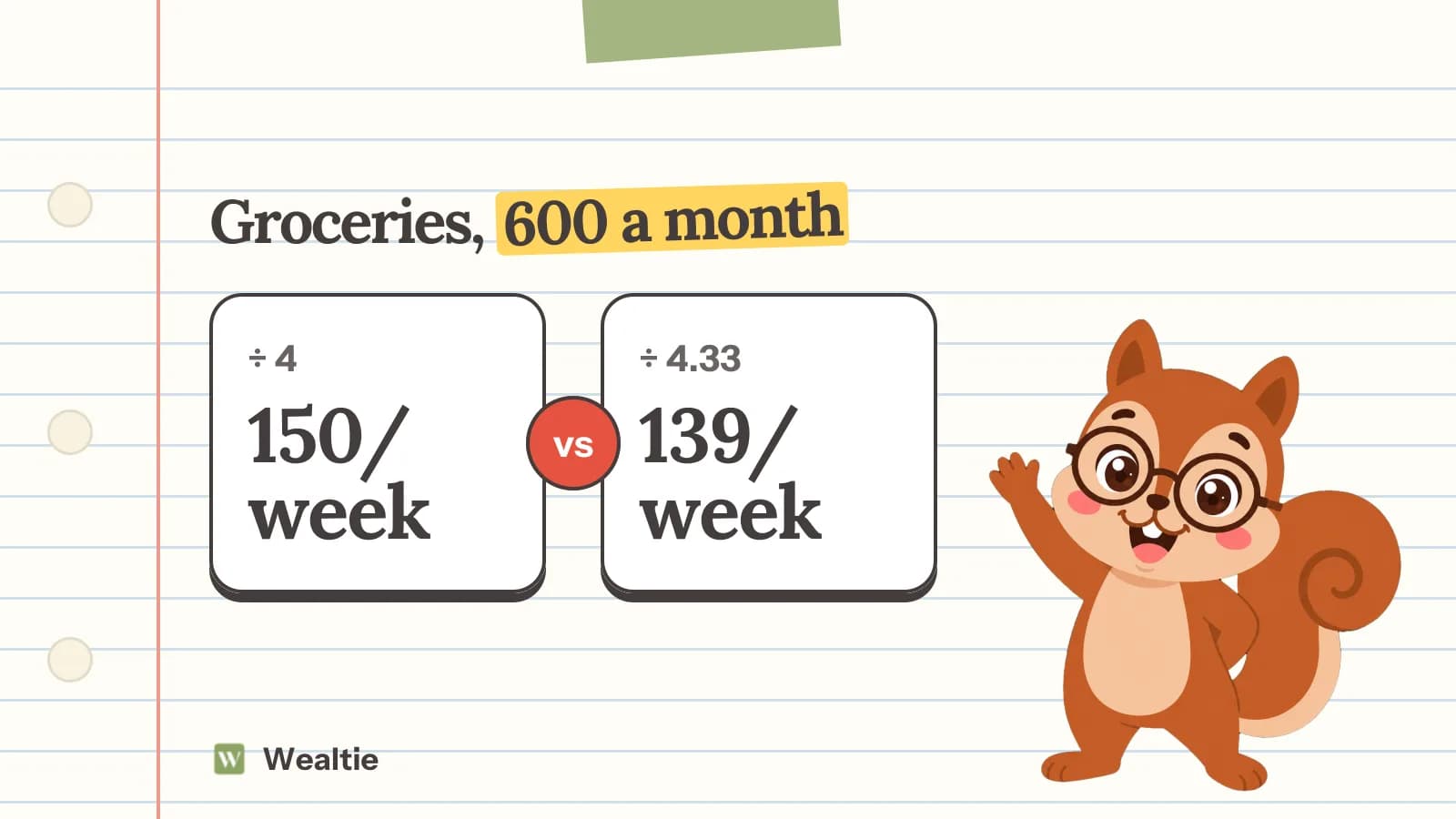
- To convert a monthly amount to weekly, divide by 4.33, not 4; a 600 monthly grocery budget is about 139 a week, not 150.
- Weekly budgets catch overspending sooner, because each week starts fresh and a bad week can't eat the whole month.
- If you're paid weekly or every two weeks, a weekly or per-paycheck budget matches when money arrives.
Weekly vs monthly budget: which is better?
Monthly for bills, weekly for everyday spending. Most people end up using both.
Bills come monthly: rent, utilities, phone, insurance, subscriptions. A monthly budget matches them. Groceries, transport, coffee and eating out happen every few days, and a monthly limit for them is easy to blow without noticing, because the first two weeks always feel generous. A weekly figure gives you four fresh starts a month.
| Monthly budget | Weekly budget | |
|---|---|---|
| Best for | Bills and fixed costs | Groceries, transport, eating out |
| Suits | Paid monthly, mostly fixed costs | Paid weekly, or overspend late in the month |
| When you notice overspending | Often at the end of the month | Within a week |
| Effort | One plan, checked once or twice | A quick check every week |
| Weak spot | The last week of the month | Monthly bills don't fit neatly |
When does a monthly budget work best?
When you're paid once a month and most of your spending is fixed. If rent, bills and savings take most of your pay and they leave by direct debit, there's not much left to go wrong, and a monthly plan with a mid-month check is enough.
A monthly budget is also the natural place to plan: income, bills, savings and the total left for spending. How to make a budget builds one in five steps.
Its weak spot is time. A month is long enough to forget what you spent in the first week. By the time you check, the overspend has already happened, and the only fix left is a tight last few days.
When does a weekly budget work best?
When you're paid weekly, when variable spending is a big share of your money, or when the overspending always happens in the last week of the month.
A weekly budget can't run out on the 20th, because there's no "rest of the month" to borrow from. A bad week is one week. You start again on Monday with the same number, and the damage is capped.
It also helps if your income arrives in pieces. If you're paid every two weeks, match each bill to the paycheck that lands before it, and run groceries, transport and eating out as weekly amounts from what's left.
Its weak spot is the bills. Rent doesn't come weekly, so a weekly-only budget has to set aside a share of each bill every week. That's more arithmetic than most people want, which is why the weekly figure works best for spending only.
How do you convert a monthly budget to weekly?
Divide by 4.33, not by 4. A year has 52 weeks, so a month has 52 ÷ 12 = 4.33 on average.
Here's a worked example in round numbers, the same in any currency:
| Spending category | Per month | Per week (÷ 4.33) | Per week if you divide by 4 |
|---|---|---|---|
| Groceries | 600 | 139 | 150 |
| Transport | 200 | 46 | 50 |
| Eating out | 260 | 60 | 65 |
| Personal spending | 240 | 55 | 60 |
| Total | 1,300 | 300 | 325 |
Dividing by 4 gives you 325 a week instead of 300. Over a year, that's 1,300 more than the monthly plan allows: a whole month's spending budget, gone in rounding.
To go the other way, from weekly to monthly, multiply by 4.33.
How do you use weekly and monthly budgets together?
Plan the month, then run the spending categories week by week.
- Monthly: take-home pay, bills, savings, and what's left for spending.
- Weekly: split the spending categories into weekly figures with the 4.33 rule.
- Each Monday: check last week against its number. Under? Leave the difference or move it to savings. Over? Take it off this week, not the end of the month.
- Mid-month: check the monthly total, so a run of slightly-over weeks doesn't add up unseen.
The bills look after themselves on the monthly plan. The weekly check is two minutes, and it's where the month is won or lost. If a week goes badly anyway, how to stop overspending covers the habits that help.
Which budget should you start with?
Start monthly if you've never budgeted. You need to see the whole month once before you can split it into weeks. After the first month, look at where it went wrong. If it went wrong in the last week, switch the spending categories to weekly.
In Wealtie, the Free plan includes a monthly budget split by category, with Budget Health warning you mid-month if your spending pace will take you over. On Pro, budgets can also be daily, weekly, quarterly or yearly, so a weekly spending limit can sit alongside your monthly plan. If you'd rather start with proportions than amounts, the 50/30/20 rule gives you a split to begin from.
Questions people ask
Use monthly for bills and weekly for everyday spending. Bills mostly arrive monthly, while groceries and eating out happen every few days, and a weekly limit catches overspending before the month is gone.
Divide the monthly amount by 4.33, the average number of weeks in a month (52 weeks divided by 12). A 600 monthly grocery budget is about 139 a week. Dividing by 4 overstates it to 150.
Yes, for spending. Set aside each week's share of the monthly bills first, then budget the rest of the paycheck for that week. It matches when money arrives.
A month is long enough to overspend without noticing. The first two weeks feel generous, and the overspend shows up in the last week. A weekly check splits the month into four chances to adjust.
Yes, and many people do. Set the monthly total and the bills, then give groceries, transport and eating out a weekly figure. The weekly figures add up to the monthly spending budget.
This article is general information, not financial, tax or legal advice. Your situation is your own; check the numbers that apply to you before you act on them.